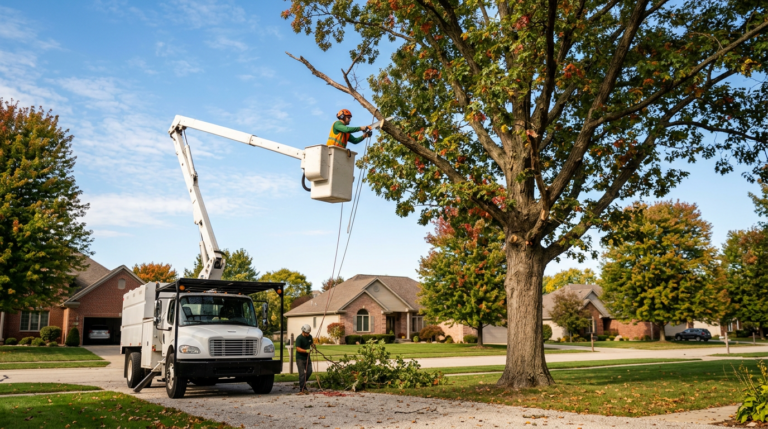
Executive Summary: Autumn in northern Illinois brings unpredictable severe weather, shifting wind gusts, and early freeze cycles that put unmaintained tree canopies under intense structural strain. Strategic tree trimming removes deadwood, balances branch weight, and minimizes hazardous wind resistance before severe weather strikes. Scheduling proactive canopy maintenance protects your home, clears utility pathways, and prevents costly emergency property repairs.
Late summer and early fall mark an important transition period for property owners across northern Illinois. As deciduous trees begin preparing for winter dormancy, structural flaws that were hidden by dense summer foliage start to become visible. Taking care of necessary canopy pruning now prevents heavy snow, sudden freeze events, and severe windstorms from tearing weak limbs away from your rooflines, vehicles, and overhead utility lines.
📌 Key Takeaways (TL;DR)
- Early Preventive Action: Pruning structural defects during September and October reduces wind resistance by up to 30%, preventing limb failure during autumn gales and early winter blizzards.
- Targeted Deadwood Removal: Eliminating diseased, dead, or competing branches redirects essential nutrients to root systems while halting insect decay before dormancy.
- Safety and Cost Control: Routine maintenance is significantly more affordable than emergency storm damage cleanup and structural tree removal after a roof or utility collapse.
🔎 Key Questions Answered for Property Owners
What is the best time for tree trimming in northern Illinois?
Early fall offers ideal visibility for inspecting canopy architecture while temperatures remain moderate. Pruning deadwood and hazardous branches before winter prevents snow loading and ice damage.How does tree trimming prevent storm damage?
Canopy thinning reduces sail effect during high winds, balances asymmetric growth, and removes compromised limbs before heavy gusts snap them onto roofs, driveways, or fences.When does a damaged tree require removal instead of trimming?
Trees with more than 50% canopy loss, hollow trunks, root upheaval, or severe structural cracks cannot recover safely and require professional tree removal.
The Rise of Severe Midwest Weather and Tree Vulnerability
Over the past several decades, weather patterns in the Rock River Valley have grown increasingly erratic. Strong autumn cold fronts colliding with lingering summer humidity generate sudden, localized wind events with gusts frequently topping 50 to 60 miles per hour. When heavy rains saturate the soil, root anchoring weakens right as high winds test the physical limits of expansive crowns.
Trees that have not received regular attention act like giant sails in a storm. Dense interior foliage traps air currents rather than allowing wind to filter through safely. This trapped force exerts massive leverage against the main trunk and union branches. If internal wood rot or weak branch unions exist, catastrophic failures occur in seconds.
In addition, early Midwestern freezes can catch fully leafed trees unprepared. Early wet snow cling to green leaves, adding thousands of pounds of unexpected load to branches that were already struggling under their own weight. Pruning before these weather shifts occur is your property’s best defense.
Understanding the Problem: Hidden Hazards in Unpruned Canopies
Many homeowners assume their trees are completely healthy simply because the leaves are green. Arboricultural health and structural integrity, however, are two entirely different factors. A tree can show vigorous leaf production while hiding significant internal hollows, pest infestations, or structural splits.
When trees grow without corrective pruning, they frequently develop several dangerous structural conditions:
- Included Bark and Co-Dominant Stems: When two main stems grow closely together in a “V” shape, bark becomes pinched between them. This prevents solid wood-to-wood connection, creating a natural fracture point that easily splits apart during high winds.
- Overextended Heavy Limbs: Horizontal branches that extend far beyond the main canopy carry immense downward torque at their attachment points.
- Dead, Decaying, and Diseased Wood: Dead limbs slowly dry out, rot, and lose all flexibility, making them prone to snapping without warning on calm days or in light breezes.
- Canopy Asymmetry: Trees competing for sunlight frequently lean or concentrate their weight on one side, placing continuous uneven strain on root systems.
| Hazard Type | Visible Warning Signs | Storm Failure Risk | Corrective Action |
|---|---|---|---|
| Co-Dominant Trunks | Tight V-shaped crotches, vertical seam fissures | Severe trunk split down the center | Subordination pruning or structural cabling |
| Deadwood Limbs | Bark peeling, brittle twigs, no leaf production | Sudden snapping onto structures below | Clean collar removal back to healthy wood |
| Excessive Canopy Density | No daylight visible through crown, crossing branches | Wind throw, root plate heave, whole-tree failure | Crown thinning up to 15-20% max density |
| Roof & Line Encroachment | Branches touching gutters, siding, or service drops | Shingle abrasion, punctured roofs, severed power | Crown clearance trimming (minimum 8-10 ft) |
Proactive Canopy Management in Practice
Professional tree maintenance is not simply cutting off branches at random. Proper arboricultural care follows strict International Society of Arboriculture (ISA) guidelines and ANSI A300 pruning standards to ensure the tree heals rapidly without creating new decay pathways.
1. Crown Cleaning and Hazard Elimination
Crown cleaning focuses on the selective removal of dead, dying, diseased, and weakly attached branches throughout the entire canopy. This is the foundational step in any safety-focused pruning project. By removing decaying wood, arborists eliminate nesting zones for destructive wood-boring insects and fungal spores that thrive in damp fall conditions.
2. Crown Thinning for Wind Filtration
Crown thinning involves selectively pruning smaller interior branches to improve light penetration and air movement through the crown. Rather than acting like a rigid wall against storm winds, a thinned canopy allows gusts to pass cleanly through the branches. This significantly reduces mechanical load on the trunk and root collar. Arborists are careful never to remove more than 15% to 20% of live foliage in a single season to prevent stress.
3. Crown Reduction and Weight Balancing
For limbs that stretch dangerously close to structures or have grown excessively long, crown reduction shortens the branch length back to an active lateral branch capable of assuming terminal leadership. This reduces the end-weight of the branch, dramatically decreasing downward gravitational stress during ice storms.
4. Structural Clearance for Structures and Service Lines
Branches overhanging roofs cause extensive damage long before a severe storm hits. As winds blow, heavy limbs rub against asphalt shingles, stripping away protective protective granules and causing roof leaks. Trimming creates safe clearance buffers—typically 8 to 10 feet above roofs and away from siding—preventing structural damage and keeping squirrels and raccoons off your roof.
When Trimming Is Not Enough: Assessing Total Tree Removal
While proactive trimming saves thousands of trees every year, there are situations where structural degradation has progressed too far for pruning to restore safety. In these cases, complete tree removal is necessary to protect occupants and neighboring properties.
Consider the following critical evaluation criteria:
- Trunk Cavities and Decay: If more than one-third of the trunk’s interior is hollow or decaying, the structural shell is severely compromised.
- Root Zone Damage: Soil mounding or lifted root plates on the windward side of a leaning tree indicate active root failure.
- Severe Leaning: A tree that suddenly develops a noticeable lean, especially following heavy rains, is an immediate emergency hazard.
- Fungal Conks at Base: Bracket fungi or mushrooms sprouting around the root flare indicate extensive internal heartwood rot.
Following tree removal, modern stump grinding equipment removes unsightly and hazardous subterranean root bases, preventing suckering growth and preparing the ground for replanting or lawn restoration.
Tailored Solutions for Residential and Commercial Properties
Every property presents unique topographical and structural challenges. A single approach to tree care will not work for an urban residential lot with tight fence lines and an open commercial business park with high foot traffic.
Here is how property owners should customize their tree management plan:
- Urban Residential Lots: Priorities include overhead power drop clearance, roof setbacks, fence line trimming, and precision sectional dismantling where heavy machinery cannot access the backyard directly.
- Suburban Acreages: Focus shifts to perimeter windbreak maintenance, large mature oak and maple preservation, deadwood clearing over long private driveways, and forest edge hazard removal.
- Commercial and Retail Sites: Emphasizes parking lot visibility, security lighting line-of-sight clearance, ADA walkway clearance, and liability mitigation against fallen limbs over customer parking bays.
- HOA and Multi-Family Complexes: Requires scheduled cyclical canopy evaluations, documented safety inspections, and centralized bulk maintenance to protect shared communal amenities.
Why Rockford Property Owners Rely on Flying W Tree Service
For over 50 years, Flying W Tree Service has proudly protected homes, businesses, and municipal spaces across Rockford, IL and the surrounding Stateline area. Established in 1972, our family-owned business brings unmatched hands-on expertise, ISA-certified arborists, and heavy-duty equipment to every job.
Here is what sets our team apart:
- Commercial-Grade Heavy Equipment: We operate 75-foot bucket trucks, heavy-duty knuckle-boom log loaders, and high-performance stump grinders capable of reaching tight spots and managing the largest tree canopies safely.
- ISA Certified Arborists: Our team members are trained in modern arboricultural science, ensuring precise cuts that preserve tree vitality while maximizing structural storm defense.
- Meticulous Property Cleanup: We never leave a mess behind. Our crews chip brush on site, rake lawns clean, haul away heavy logs, and leave your property looking spotless.
- Clear, Honest Estimates: We provide free, transparent, written on-site estimates so you know exactly what work is needed with zero hidden fees.
- Fast Emergency Storm Response: When severe storms tear through northern Illinois, our local crews respond promptly with dedicated storm damage cleanup equipment.
Frequently Asked Questions About Tree Care
Q: How frequently should mature trees in northern Illinois be trimmed?
Most mature hardwood trees, such as oaks, maples, and ashes, should receive a professional structural inspection and trimming every 3 to 5 years. Fast-growing species like willows, silver maples, and river birches may require attention every 2 to 3 years.
Q: Is early fall a safe time to trim oak trees?
In northern Illinois, oak pruning should strictly occur when vector beetles are inactive to avoid spreading Oak Wilt disease. Waiting until late summer and early autumn when temperatures drop, or completing pruning during full winter dormancy, is the recommended safety window.
Q: What should I do if a tree branch falls on power lines near my home?
Never attempt to touch or trim branches touching power lines. Immediately stay clear of the area and contact your local electric utility provider. Once the utility declares the line safe or de-energized, contact a licensed tree service to remove the fallen wood.
Q: Does home insurance cover preventive tree trimming?
No. Homeowner insurance policies cover sudden, accidental storm damage resulting from fallen trees, but they do not cover routine maintenance or preventive trimming. In fact, if an insurance adjuster determines that a fallen tree was visibly dead or neglected, they may contest or deny property damage claims.
Q: How does stump grinding work after a tree is removed?
Stump grinding utilizes a high-powered rotating wheel with carbide teeth to grind the tree stump and surface roots 6 to 12 inches below grade level. The resulting wood mulch can be used in your garden beds or hauled away for clean topsoil and turf seeding.
Protect Your Property Before Severe Storms Arrive
Your trees are among the most valuable assets on your property, providing shade, beauty, and environmental benefits. When neglected, however, overgrown and weakened canopies turn into dangerous liabilities during autumn and winter storms. Taking proactive steps today ensures your trees remain healthy and strong for decades to come.
Whether you need preventive tree trimming, precision hazard removal, or complete stump grinding, the experienced team at Flying W Tree Service is ready to help across Rockford, IL. Contact our certified arborists today at (815) 965-7698 or visit flyingwtreeservice.com/estimate to request your free, on-site property evaluation.