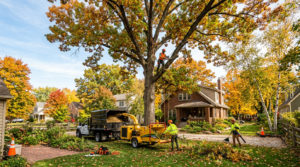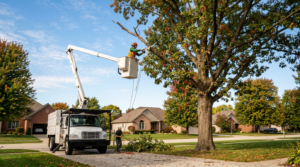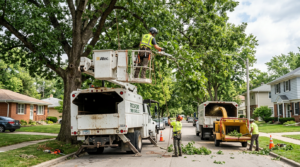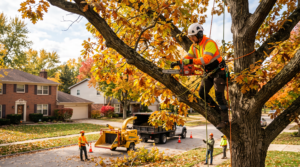
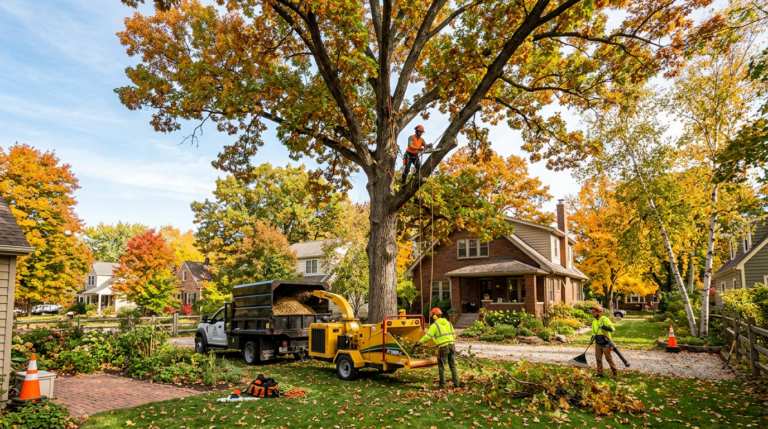
Autumn in Northern Illinois brings crisp air, vibrant foliage, and unpredictable weather patterns. Preparing mature trees for seasonal changes protects roofs, driveways, and utility connections from unexpected failure. Timely seasonal pruning eliminates weak limbs before heavy autumn winds and wet winter snow cause structural breaks.
Key Questions Answered:
- Why is tree trimming important in autumn? Pruning before winter removes decaying wood and thins dense canopies, reducing wind resistance and preventing snow-load branch breakage.
- When should damaged trees be removed instead of trimmed? Severe internal rot, trunk splitting, or root decay across more than 40 percent of the canopy warrants complete tree removal.
- What happens to the stump after tree removal? Stump grinding removes the remaining wood below ground level, eliminating fungal pockets, pest habitats, and tripping hazards.
Property owners in northern Illinois face distinct climate stresses every year. Early freeze-thaw cycles combined with high-velocity windstorms place heavy strain on unmanaged canopies. When tree branches grow unevenly or carry deadwood, sudden seasonal gusts turn overlooked defects into expensive property damage.
- Proactive autumn tree trimming reduces canopy drag and prevents severe storm damage during Northern Illinois winter freezes.
- Inspecting tree forks and removing deadwood prevents hazardous limb drop over roofs, power lines, and driveways.
- When decay compromises structural stability, combining full tree removal with stump grinding ensures complete property safety.
The Rise of Preventive Tree Maintenance in Northern Illinois
Over the past decade, unpredictable weather shifts have driven a noticeable increase in severe seasonal storms across the Midwest. Homeowners and commercial facility managers in Rockford, IL have moved away from reactive emergency cleanups toward structured, preventive care programs.
Neglecting seasonal canopy management often results in costly emergency repairs. Heavy precipitation saturated into dense branches adds thousands of pounds of mechanical stress to a tree trunk. When strong autumn fronts blow across the Rock River valley, unpruned branches act like sails, catching the wind and transmitting excessive torque directly into the root plate.
Industry research from organizations like the International Society of Arboriculture (ISA) demonstrates that regular structural pruning significantly lowers the risk of catastrophic limb failure during high-wind and ice events. Maintaining clear canopy spacing allows strong gusts to pass through cleanly rather than tearing main boughs away from the trunk.
Tree Trimming in Practice: Key Steps for Pre-Winter Canopy Health
Professional tree care requires a clear understanding of tree biology, load distribution, and seasonal growth patterns. Effective pruning during early autumn involves targeted cuts that encourage natural defense barriers before freezing temperatures arrive.
Identifying Deadwood, Overgrowth, and Weak Unions
The first phase of any seasonal maintenance plan is a thorough visual and mechanical inspection of the tree canopy. Certified arborists inspect the structure for three critical risk indicators:
- Dead, dying, or diseased branches: Brittle wood cannot flex under wind or snow loads and will snap without warning.
- V-shaped co-dominant stems: Narrow junction angles often contain included bark, making them prone to splitting down the center under heavy mechanical stress.
- Crossing or rubbing limbs: Friction between adjacent boughs wears down protective bark layers, creating entry portals for wood-boring insects and decay fungi.
Structural Pruning Techniques for Heavy Snow Loads
Winter precipitation in Winnebago County frequently shifts between wet, heavy snow and dense sleet. Structural pruning focuses on redistributing branch weight toward the interior trunk while preserving natural tree shape.
By shortening excessively long, lateral boughs and removing erratic water sprouts, arborists reduce leverage along primary branches. This careful weight reduction keeps boughs flexible enough to bend safely under snow accumulations rather than splintering over structures.
Balancing Crown Thinning and Crown Raising
Canopy thinning selectively removes smaller branches throughout the outer crown to increase air penetration and sunlight filtration. It reduces wind drag without stripping the internal foliage needed for spring vitality.
Crown raising lifts the lower canopy by pruning bottom limbs that hang too close to rooftops, walkways, service wires, or vehicle access paths. Maintaining clearance of at least ten feet above driveways and structures protects building materials from abrasive branch contact during sustained windstorms.
When Tree Trimming Shifts to Tree Removal and Stump Grinding
While trimming preserves and strengthens viable trees, certain structural defects indicate that a tree has reached the end of its safe lifespan. Recognizing the boundary between salvageable growth and imminent hazard protects both lives and real estate.
Signs That a Tree Cannot Be Saved Safely
When decay spreads into core structural wood, pruning alone cannot guarantee safety. Property owners should consider complete tree removal under the following conditions:
- Extensive trunk hollows or cavities: If more than one-third of the trunk circumference shows active rot or cavity formation, the tree lacks the strength to withstand severe storms.
- Severe root damage or soil heaving: Upheaved soil mounds, cracked sidewalks near the base, or mushroom clusters fruiting on root flares indicate extensive root failure.
- Sudden lean: A tree that develops a noticeable lean after a recent storm has experienced subsurface root shear and must be removed promptly.
- Dieback across the main crown: Large-scale crown decline exceeding 50 percent indicates systemic vascular collapse, often caused by root rot or severe pest infestations.
Eliminating Subsurface Hazards with Stump Grinding
After a hazardous tree is safely dismantled and hauled away, the remaining stump presents its own set of challenges. Leaving a stump in place invites carpenter ants, termites, and wood-rotting fungi like honey fungus (Armillaria), which can spread underground to infect neighboring healthy trees.
Professional stump grinding utilizes powerful cutting wheels to grind the root collar 6 to 12 inches below ground grade. This process turns old wood into clean mulch, prevents unwanted sucker sprouting, and levels the lawn for replanting, paving, or sod installation.
Tailored Solutions: Assessing Tree Care by Property Size and Tree Species
Every landscape features unique structural layouts, soil dynamics, and species compositions. Tailoring tree care solutions to specific property requirements ensures maximum safety and longevity.
- Residential Properties: Focuses on roof clearances, service drops, fence protection, and family safety in play areas. Work typically emphasizes careful rigging and tight-space lowering techniques.
- Commercial Grounds & HOAs: Prioritizes pedestrian liability mitigation, parking lot sightlines, clear commercial signage views, and scheduled multi-tree maintenance cycles.
- Hardwood Species (Oaks, Maples, Hickories): Requires precise pruning timing to avoid seasonal pest transmission, such as Oak Wilt beetles. Pruning during dormant or early autumn windows ensures rapid wound compartmentalization.
- Softwood & Fast-Growing Species (Willows, Silver Maples, Cottonwoods): Prone to brittle wood and rapid limb sprawl. Requires regular canopy thinning and aggressive weight reduction on overextended limbs.
- Proximity to Utility Lines: Demands certified equipment, 75-foot bucket trucks, and specialized insulated safety gear to clear overhead lines without risking power disruptions.
Comparing Seasonal Tree Care Priorities
Understanding which tree care tasks correspond to seasonal milestones helps property managers maintain healthy landscapes year-round.
| Season | Primary Objective | Key Actions | Primary Benefits |
|---|---|---|---|
| Late Summer / Early Autumn | Storm Prep & Hazard Mitigation | Deadwood removal, crown thinning, roof clearance | Reduces wind sail effect, prevents autumn storm breakage |
| Winter (Dormant Period) | Structural Shaping & Oak Pruning | Major structural corrections, hazardous tree removal | Minimal disease transmission, clear branch visibility |
| Spring | Storm Recovery & Health Boost | Post-winter cleanup, broken limb extraction, mulch rings | Accelerates spring flush, protects fresh soil moisture |
| Summer | Maintenance & Monitoring | Sucker removal, pest inspections, clearance trimming | Maintains lawn access, prevents storm branch rubbing |
Why Choose Flying W Tree Service for Your Rockford Property
For property owners across Rockford, IL and the surrounding communities, selecting the right tree care specialist makes all the difference in safety, efficiency, and property value. Since 1972, Flying W Tree Service has provided dependable tree management backed by more than 50 years of hands-on regional experience.
Equipped with 75-foot bucket trucks, high-capacity log loaders, advanced stump grinders, and precision rigging systems, our team handles projects of any scale safely. From delicate precision trimming near historic roofs to large-scale hazardous tree removals and rapid storm damage cleanups, we bring safety and thorough job-site cleanup to every single property.
Frequently Asked Questions About Tree Trimming in Rockford, IL
How often should mature trees in Northern Illinois be trimmed?
Most mature shade trees benefit from comprehensive trimming every 3 to 5 years. Rapidly growing or softer species like Silver Maples and Willows may require inspection and light structural trimming every 2 years to control brittle overgrowth and prevent storm hazards.
Can tree trimming be performed late in the season?
Yes. Early autumn and the approaching dormant winter months provide excellent conditions for tree pruning. With leaves dropping, arborists gain an unobstructed view of branch architecture, structural defects, and hidden cracks that require correction.
What is the difference between topping a tree and crown thinning?
Tree topping involves indiscriminately cutting back large limbs to stubs, which severely damages tree health, promotes rapid weak sucker growth, and introduces internal rot. Crown thinning, on the other hand, selectively removes specific secondary branches while preserving the tree’s natural shape and structural integrity.
Do I need to be home when tree trimming or stump grinding is done?
As long as our crew has clear access to the work area, unlocked gates, and all vehicles or outdoor furniture are moved away from the drop zone, you do not need to be on-site during the service. Our team manages complete debris cleanup and disposal before departing.
Protecting Your Property Before Winter Arrives
Taking care of canopy maintenance before winter freezes arrive is the most reliable way to prevent sudden property damage and preserve the beauty of your yard. Routine tree trimming strengthens branch structure, eliminates hidden decay, and provides lasting peace of mind through every seasonal storm.
Flying W Tree Service delivers professional tree trimming, hazardous tree removal, and precision stump grinding across Rockford, IL. Reach out to schedule a property walkthrough and receive a clear, free estimate from experienced local tree care specialists.